Showcase Collection
Curated limited-edition celestial prints featuring real archival NASA imagery from the WISE telescope. Each edition is numbered and individually produced.
Collection
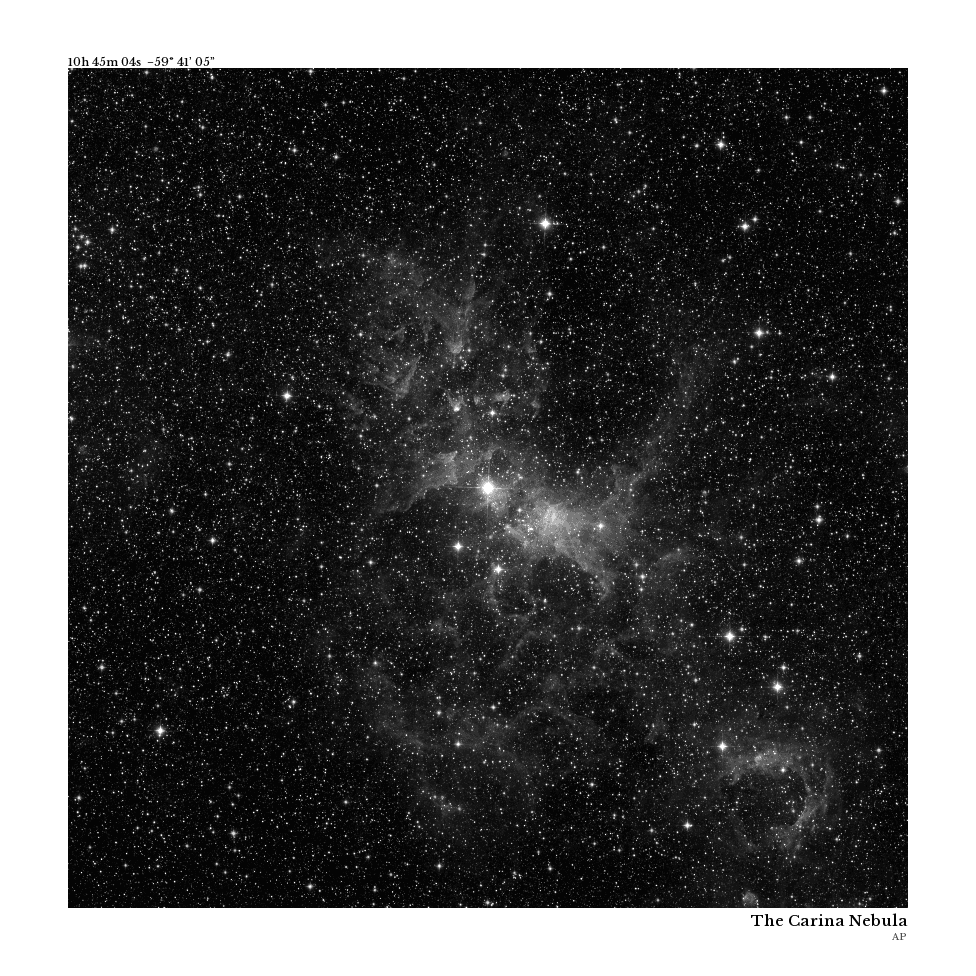
The Carina Nebula
AvailableNebulae
Eta Carinae is one of the most massive, unstable stars known — a binary system about 7,500 light-years away that erupted so violently in 1843 it briefly became the second brightest star in the sky. It's surrounded by the Homunculus Nebula (the expanding debris from that eruption) and embedded in the much larger Carina Nebula, which dwarfs the Orion Nebula by a factor of four. In infrared WISE imagery, this region is spectacular — all that warm dust and gas lights up beautifully in IR bands.
100 of 100 remaining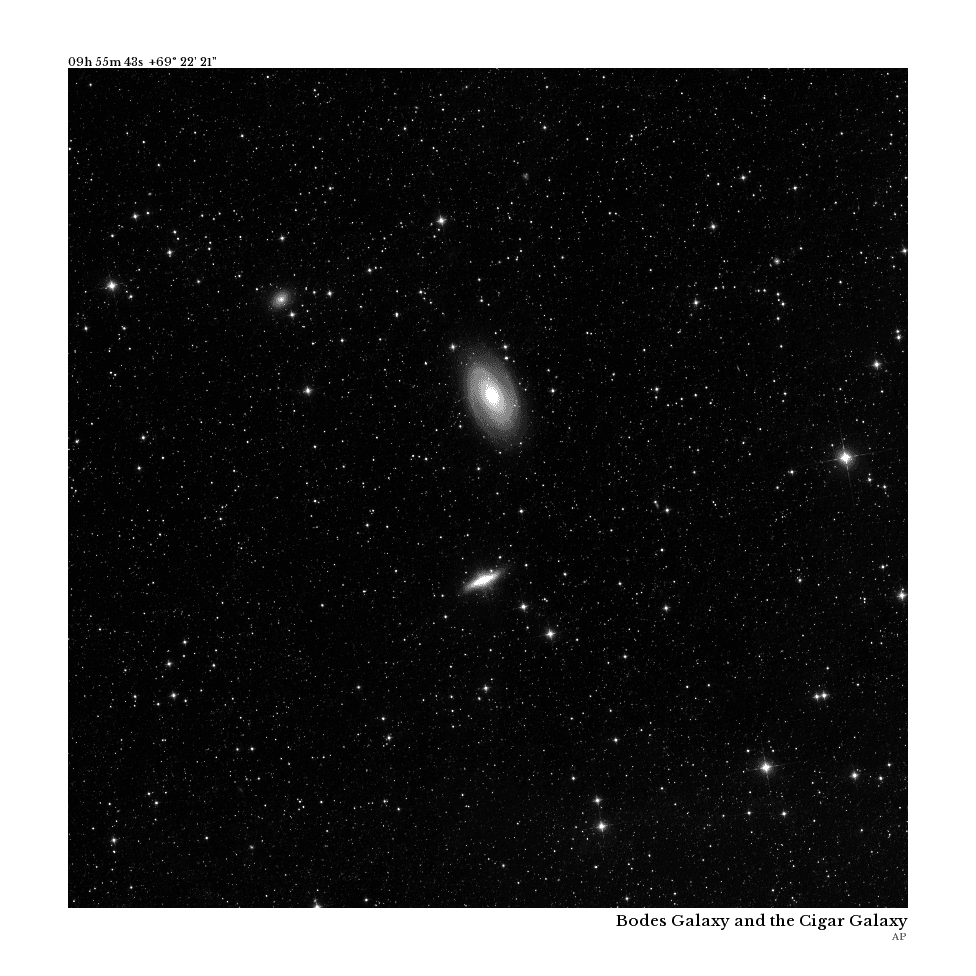
Bodes Galaxy and the Cigar Galaxy
AvailableGalaxies
These two galaxies sit about 12 million light-years away in Ursa Major, close enough to be gravitationally entangled with each other. M81, Bode's Galaxy, is a textbook grand-design spiral — elegant, symmetrical, with sweeping arms of young blue stars tracing its rotation. Its companion M82, the Cigar Galaxy, is the opposite: a starburst galaxy ripped into overdrive by a close encounter with M81 roughly 300 million years ago. That gravitational interaction compressed M82's gas so violently that it's forming new stars at ten times the rate of a normal galaxy, and super-heated plumes of gas are being blown thousands of light-years above and below its disk. Seen together in the same field, they're a study in contrast — one calm and ordered, the other in beautiful, productive turmoil.
100 of 100 remaining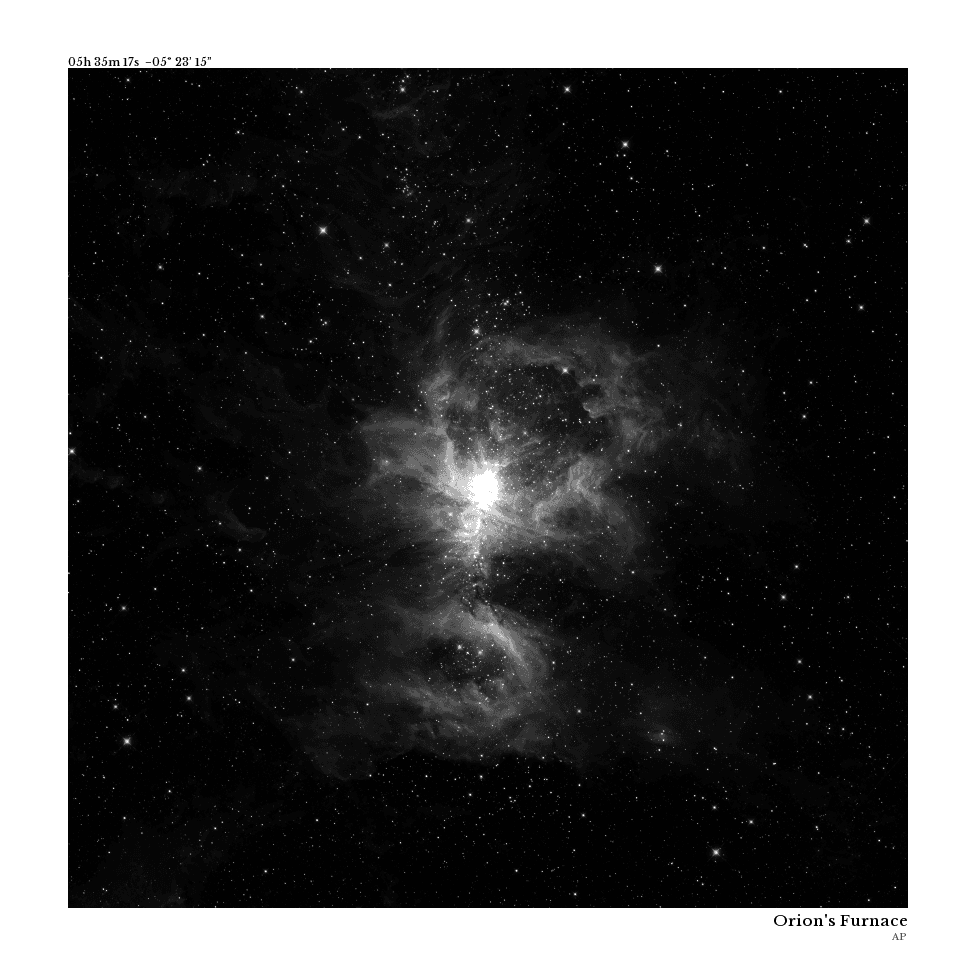
Orion's Furnace
AvailableNebulae
The Orion Nebula is the closest large stellar nursery to Earth — a vast cloud of gas and dust roughly 1,350 light-years away where new stars are being born right now. At its core, four young blue-white stars known as the Trapezium blast the surrounding hydrogen with ultraviolet radiation, causing it to fluoresce in shades of red, pink, and violet. The nebula spans about 24 light-years across and contains enough raw material to form thousands of new solar systems. Even to the naked eye it's visible as a faint smudge below Orion's belt — the middle "star" of his sword. It has been a milestone in astronomy since the 1600s: one of the first objects ever photographed through a telescope, and still one of the most studied regions of space. Within its folds, protoplanetary disks have been directly imaged — planets in the act of forming around infant stars.
100 of 100 remainingLooking for something personal?
Create a custom star print of any moment — a birth, wedding, anniversary, or any night that matters to you.
Create Your Moment